
- Market Value
- Storage
- (1) Centralized Server
- (2) IPFS
- NFT Storage on Crust
- Detailed Process
- About Crust Fire Cloud
- About PolkaPets
- Crust NFTs Value
- Common Ways to Store NFTs
- Where Do NFTs Go After You Have Bought Them?
- Hardware Wallets Explained
- Advantages of Hardware Wallets
- Comparison between “Hot” and “Cold” Wallets
- Other ways of storing NFTs
- Frequently Asked Questions
- What will happen to my NFT if the platform I purchased it on disappears?
- How can my NFT get hacked or stolen?
- Is it necessary to secure my NFT collection?
- IPFS architecture
- Filecoin, or IPFS on the blockchain
- Problems with IPFS as permanent storage
- How you can avoid being fooled
- So what does this all mean?
- Filecoin and IPFS
- Why Three Different Storage Systems?
- Estuary
- Web3. storage
- NFT. storage
- 2 Technological Elements
- 1 Protocol Standards.
- 3 Key Properties
- 4 Risk Assessment
- A) Metaverse
- B) Digital Collectibles
- C) Games
- 1 Metaverse Value Support
- 3 Enormous Capital Market
Market Value
According to the latest estimates from nonfungible. com, which monitors the NFT market, the market value of NFTs has increased by 705% since the end of 2020, reaching $3. 38 billion. Until the end of February this year, NFT’s sales were close to $3. 1 billion, almost five times the full-year sales in 2020.
Storage
If you want to store metadata off chain, then you have two options:
(1) Centralized Server
The simplest metadata storage solution is to store it on a centralized server or cloud storage solution like AWS. The disadvantages of centralization are obvious:
1) Developers can change metadata randomly.
2) If the project is offline, then metadata may be destroyed.
(2) IPFS
IPFS is a peer-to-peer file storage system that allows content to be stored between computers, so that files can be backed up to multiple different nodes. This ensures that the metadata is immutable because it is uniquely addressed by the hash of the file, and as long as one node is willing to host the data, the data will continue to exist over time and will not be impossible to retrieve due to the shutdown of the project.
Now, developers can simplify this process for efficient storage through the open Crust Storage Network.
NFT Storage on Crust
The NFT trading platform imports the NFT file into IPFS;
The NFT trading platform stores and distributes NFT files through the Crust network;
The NFT trading platform monitors the storage status of NFT files on the Crust network;
Detailed Process
The NFT platform needs to run an IPFS node. When the NFT is generated, the trading platform imports the NFT file into IPFS.
All files imported into IPFS will get a unique CID (anyone can retrieve the corresponding file in the IPFS network through this CID).
In the return value obtained, the CID is: QmbLmgLUR1VZNpttojd752fyng8Bz3ZbPqabQ76MVLXT7P
Store and Distribute NFT Files through the Crust Network
When the NFT file is imported to the IPFS network, we need the Crust network node to Pin the file and provide retrieval to ensure that the file can always be accessed.
1 Installing Dependency
NFT trading platform installs the corresponding dependency of Crust.
2 How to Initialize the API
The NFT trading platform initializes the API on the server to interact with Crust Network.
// WS address of Crust chainconst chain_ws_url = “ws://127. 1:9933”;// Connect to chainprovider: new WsProvider(chain_ws_url),
3 Set the Identity on the Chain
The NFT trading platform needs to obtain a KeyringPair on the chain to send order transactions. It can be generated from the seeds of the account:
/* eslint-disable node/no-extraneous-import */// Seeds of account// krp will be used in sending transactionconst krp = kr. addFromUri(seeds);
4 Initiating a Storage Order on the Crust Network
* Place stroage order// Determine whether to connect to the chain// Generate transactionconst pso = api. market. placeStorageOrder(fileCID, fileSize, tip, false);const txRes = JSON. parse(JSON. stringify((await sendTx(krp, pso))));
5 Crust Storage File
A large number of nodes in the Crust Network will obtain the corresponding NFT file through the IPFS network after monitoring the storage order, ensuring high availability and fast download speed of the file.
Monitor the Storage Status of NFT Files in the Crust Network
* Get on-chain order information about filesreturn await api. query. market. files(cid);
In addition to accessing the Crust Network through code, you can also monitor file storage status through Crust Apps:
NFT File Retrieval and Access
For example: for the NFT file Firecloud. png, the URL accessed through the public Gateway of IPFS is:
About Crust Fire Cloud
Crust Fire Cloud is extremely efficient and fast. They are serious by nature and get right down to business. They pride themselves on being highly motivated and being able to get things done with speed and precision. Their ambition and determination make them great partners in battle. In its downtime, Crust loves jumping and running around rocky areas and climbing high up in trees. When angered they have the ability to suck in heat around them and unleash a powerful fire. They have to be careful as they do not want to accidentally set their habitat on fire. They do not bode well in places with water.
About PolkaPets
The World of PolkaPets is an NFT Collectible Card Game Universe where each PolkaPet, embodied as an artistic creature, represents a specific project within the PolkaPet ecosystem. The abilities, behaviors, and strengths of each creature are connected to the specific vision of the Polkadot project that the creature represents.
Each PolkaPet will hold a unique utility that rewards community members for holding that specific PolkaPet NFT in their wallet. This could be a discount on fees, an airdrop of tokens to PolkaPet cardholders, and much more.
Also, in the PolkaPets TCG, players will be able to pair their PolkaPets against each other in competitive gameplay. Players will earn rewards by winning tournaments, completing storyline tasks, and more.
Crust NFTs Value
Crust implements the incentive layer protocol for decentralized storage. It is adaptable to multiple storage layer protocols such as IPFS, and provides support for the application layer. Crust’s architecture also has the capability of supporting a decentralized computing layer and building a decentralized cloud ecosystem.
At present, Maxwell Preview network is live, and welcomes everyone to join for testing. Crust Network successively joined Substrate Builders Program and Web3. 0 Bootcamp, and also obtained a Web3 Foundation Grant.
Common Ways to Store NFTs

Common Ways to Create NFTs
Where Do NFTs Go After You Have Bought Them?

Where do your NFTs go after you bought them?
Newbies to NFTs frequently inquire, “Where do my NFTs go once I purchase them?” and often Google ‘How to store NFT assets’.
While NFT platforms make it easy to browse the NFT collections you possess, it’s critical to understand their physical location.
Hence, the NFT (non-fungible token) serves as a means of establishing ownership of the item you purchased, but the image itself resides elsewhere on the internet, for example, the OpenSea website if you bought it on Opensea.

MetaMask – A Major Wallet
MetaMask allows you to trade your tokens directly from the app. A DEX (Decentralized Exchange) such as Uniswap can be used manually or you can utilize the built-in Swaps function in the MetaMask wallet (the browser extension version and the mobile app version both offer this feature).
No need to use a Separate app to purchase crypto tokens. Since the wallet allows the capability to easily buy Ethereum using a credit card or debit card inside the dApp, you don’t need to use a separate app to purchase Ether or ERC20 tokens using MetaMask.
MetaMask makes it simple to swap tokens right from your wallet. To use MetaMask, you don’t need to register a second account on any of these platforms, which is a huge time-saver when you get the hang of it.
In MetaMask, you can directly purchase funds.
Hardware Wallets Explained

The word “wallet” conjures up images of a compartment, box, bag, or vessel in which we can keep our actual cash. However, this is not so of cryptocurrency hard wallets. It is possible to store tokens offline using hardware wallets (also known as “cold storage wallets”), which are actual devices.
Your private key is the only means to control the ownership of your tokens in a virtual currency, and cryptocurrencies don’t exist in a material form. Your crypto assets must be stored and managed in a specific wallet.
If the device is linked to the internet, it may be used as a hot wallet (like MetaMask), making it both easy and safe.
A device password and a personal ID are included with most hardware wallets like the Ellipal Titan, ledger, and Trezor, although this is not always the case. It’s also possible to restore your data on a stolen or lost hard wallet device provided you secure your private keys.
Advantages of Hardware Wallets
The major question investors ask is the advantages of hardware wallets in an internet age. The advantages of hardware wallets are:
Minimizes risks associated with Data Breaches.
The private keys are not made public.
Your hardware device is the only place where you’ll need to store your private keys. Your private key cannot be hacked or duplicated because it never makes it to your machine.
Verification of the Device
You can’t verify your online transaction on a computer; you need to do it on your hardware wallet. Because of this, no one can use your smartphone to do transactions without getting your permission first. You are certain at all times that your money is protected so long as you keep your hard wallet device secure.
Encryption of Pin improves security
The hardware wallet is secured with an encrypted pin. This pin is generated by you and only you know its secret. The device will self-destruct after the third incorrect pin enter if anyone attempts to forcefully activate it. To keep your money safe, both the public and private keys are removed from the device.
The device is immune to Virus Infection
Due to the nature of virus attacks on system software, your hardware wallet is not vulnerable. Unlike software wallets, hardware wallets are impenetrable, making them the safest alternative for storing your cryptocurrency.
Comparison between “Hot” and “Cold” Wallets
Obviously, cold wallets are the most secure solution when it comes to protecting your cryptocurrency assets.
A variety of factors come into play while selecting whether to use a hot or cold wallet, such as: how frequently you buy and sell NFTs, How much your NFTs mean to you (that is, how risky it will be to lose them) Whether you place more importance on comfort or safety or not and the value of your NFTs,
A cold wallet is great for long-term NFT storage if you don’t plan on using it regularly, but if you plan on trading frequently, a hot wallet may be handier for your needs.
For those who are fortunate enough to own one of the rarest “Pak’s ‘The Merge,” ‘NBA Moments” or Cryptopunks worth millions of dollars, it’s imperative that they do everything they can to ensure that they retain ownership of their prized possession until they decide to sell it. It doesn’t matter if you have NFTs that isn’t worth much right now, but you believe they’ll appreciate in the future; hard wallets are a good way to protect your money.
Hardware wallets are an excellent idea if you’re concerned about security or have valuable NFTs. However, you should only acquire hardware wallets from the company’s official site and avoid lesser-known hard wallet providers.
Other ways of storing NFTs

IPFS. Image Credits: ipfs
NFTs can be stored in a variety of ways, some of which are less well-known than others. Here are some of the most well-known:
InterPlanetary File System (IPFS)The IPFS is an open-source project from Protocol labs. It is used for storing and accessing websites, data, files, and applications.
There is a lot of potentials for IPFS to serve as a foundation for a new, decentralized web because of how widely distributed it is and how easy it is to use. It eliminates the need for servers and fundamentally alters how the internet functions. A single physical location is not required to store digital data utilizing IPFS, which means that any type of data can be accessed from anywhere even outside the planet. A decentralized internet is what you get with IPFS!
This means that if you use platforms like Pinata and Filecoin to store your own NFTs, you won’t have to worry about their ever being lost, such as if the marketplace where they are stored goes out of business or something like that happens.
Frequently Asked Questions
The best place you can store your NFT data is on a hardware wallet.
What will happen to my NFT if the platform I purchased it on disappears?
Owners of NFTs are concerned about this. Fortunately, the token or certificate of ownership, known as the NFT, will always exist. However the file which it is connected with (e. digital painting, etc. ) would theoretically no longer be accessible through the web address that the certificate links to. In the meantime, no single new technology, such as IPFS, has been selected as the official solution to this potential issue, though they are still being considered as potential solutions.
How can my NFT get hacked or stolen?
The digital sigature that indicates you possess an NFT cannot be stolen or duplicated in the same way that digital photos or source code can merely be copied from the internet. You can copy the file but not the digital signature.
Is it necessary to secure my NFT collection?
Yes, it is. You spent money to acquire these NFT collectibles, they represent valuable assets, hence, must be secure.
IPFS architecture
To get onto the IPFS network you can put up a node, using instructions here, and begin hosting files. When you put a file onto IPFS you create its content ID, or CID, which is a complicated set of hashes based on where the file is located and related metadata. That file can then stay hosted on your node alone, or it can be distributed among many nodes. This is where it is like BitTorrent. Just because a file is available “on BitTorrent” doesn’t mean there are any seeders or that it’s there forever. IPFS is like this. The address/CID is permanent, to a degree as it gets passed around the DHT, but the underlying asset, or file, that the IPFS address points to can be lost as easily as any file on any random web server. CoinDesk could run an IPFS node to store its article archive, and it wouldn’t make them any more permanent than they are now.
Filecoin, or IPFS on the blockchain
Many NFT projects use Filecoin to give their buyers the feeling of permanence. Even more use IPFS addresses to give the sense of reliability, as IPFS has won accolades by some of tech’s biggest names.
However, using IPFS broadly obfuscates the real permanence of NFT-secured assets. It’s an open secret that many NFT projects simply use random web file storage to host their images, and that those could go away at any time. The solution for “savvy” NFTs buyers is to only consider projects where the “art” is hosted on IPFS.
But often an IPFS link just points to that same website you didn’t trust the project creators to maintain. Filecoin hosted storage might be an easier way to provide some reliability for NFT storage, but it is far from perfect.
Problems with IPFS as permanent storage
Honestly, IPFS might as well be a. torrent file that points to a reliable IP address hosting the DHT table for the files you want to host. It’s a little bit more elegant than that, but it really does boil down to the same thing.
No matter what you do with the storage, someone has to host it physically somewhere. There might be layers of incentives provided to ensure that the storage stays up, but it still needs to be on a hard drive somewhere connected to the internet.
Even when a file is hosted on Filecoin you are reliant on the Filecoin nodes it’s hosted on not to go dark during a bear market for the Filecoin team to not introduce a catastrophic error ever. and for the IPFS gateways that are used to access your files stay up.
There are a lot of centralized points of failure here for a decentralized file storage system.
How you can avoid being fooled
From what I can tell, there is no easy way to determine how a file on IPFS is being hosted without running your own IPFS node and using that software to do a lookup of the hash.
ipfs dht findprovs $CHUNK_HASH
It is not foolproof as it will only list what nodes are hosting the file that your node can find. However, these files do not distribute automatically and hosting a file is an active process as is pushing it to new nodes. To do this you need to know exactly what file you are looking for and its hash.
Even if you are storing your data on Filecoin you aren’t really accessing it from there when reading the NFT. While a file might be “backed” on Filecoin, transacting with that network requires fees and apparently unsealing a file to read can take hours. To get around this, Protocol Labs developed the FileCoin Pinning Services that hosts files like IPFS. It’s basically just IPFS nodes that grab stuff off Filecoin and host it for a price.
This is all starting to feel like centralized storage with extra expensive and complicated steps. The worst part is that people are putting huge amounts of money into NFTs thinking they’ll last a lifetime, when they are simply files on a file server somewhere that someone (not you) ultimately controls. NFT marketplaces sometimes even have a business incentive to remove your file from the directory.
So what does this all mean?
Basically, NFTs are no more permanent than any other part of the web. They use fancy, useful technology to obfuscate the fact that unless you are hosting the file that your NFT represents yourself you are beholden to others.
Right now, an NFT hosted using Filecoin has as good a chance as anything of sticking around. But, like everything else in this world, it comes down to trust. Do you trust that the entity that created your NFT has put the effort in to ensure reliable access? Do you trust that Filecoin won’t shut down?
Filecoin and IPFS
IPFS is a distributed system for storing and accessing files, data, and applications. If you’re aware of how file systems usually work, they access data based on the organization of that data. While a FAT file system uses an allocation table to look up data, and an NTFS file system uses hard links and data streams, IPFS uses content IDs (CIDs). When a developer needs to access an application or data stored on the IPFS network, they need to have a copy of that CID.
If, for example, a node goes down for whatever reason, the information is available on other nodes as a backup. The IPFS gateway can simply load the data from another backup node, using the CID to gain access to it.
Understanding how Filecoin and IPFS work together, we can begin to appreciate gateway systems like Estuary, Web3. storage, and NFT. storage.
Why Three Different Storage Systems?
If they perform the same functions, why do we need three versions of the same thing? Each solution is designed for a particular purpose and a particular audience. To truly get a feel for what each of them does, we need to look at them in detail.
Estuary
Estuary is designed for clients who have large data storage needs, the feature set currently supports to making up to six hundred deals per hour and each Estuary node has a storage capacity that pushes the ceiling of what exists in the ecosystem
As soon as the deal is created, you get a link to the CID. You can use this CID in your app or website to retrieve your data from any public IPFS gateway, since your data is now accessible from a globally distributed network. Even if your data is not backed up to Filecoin yet and is still staged on Estuary, you can still retrieve the CID from any IPFS gateway, allowing you to develop seamlessly without worrying about whether data has been added to the Filecoin ecosystem.
Estuary uses the IPFS pinning standard so it is easy to switch from other existing solutions. Estuary is perfect for anyone writing software that requires shuttling large amounts of files of any size. Estuary doesn’t require a specific programming language and can be used in a way that feels the most natural to you. Because of its intuitive nature, rollout of apps and websites can be uncomplicated.
Web3. storage
Just like Estuary, you will need an API key to access the system, but that’s a simple matter of opening a free account and uploading a file. Once you have that file, you can use the API key to access it through curl or directly through the browser.
To make it easier to build a web app, there’s a direct JavaScript interface to use IPFS from within your code with just a few lines. The script to build an IPFS node needs the API key to work, but it can be copy-pasted from the documentation on the site.
You can access files directly through their CID and start streamlining your JavaScript app to use data stored on the IPFS network. The simplicity of use makes this an ideal storage solution for developers building JavaScript-based applications who want to use Web3. storage to upload and retrieve their files directly.
NFT. storage
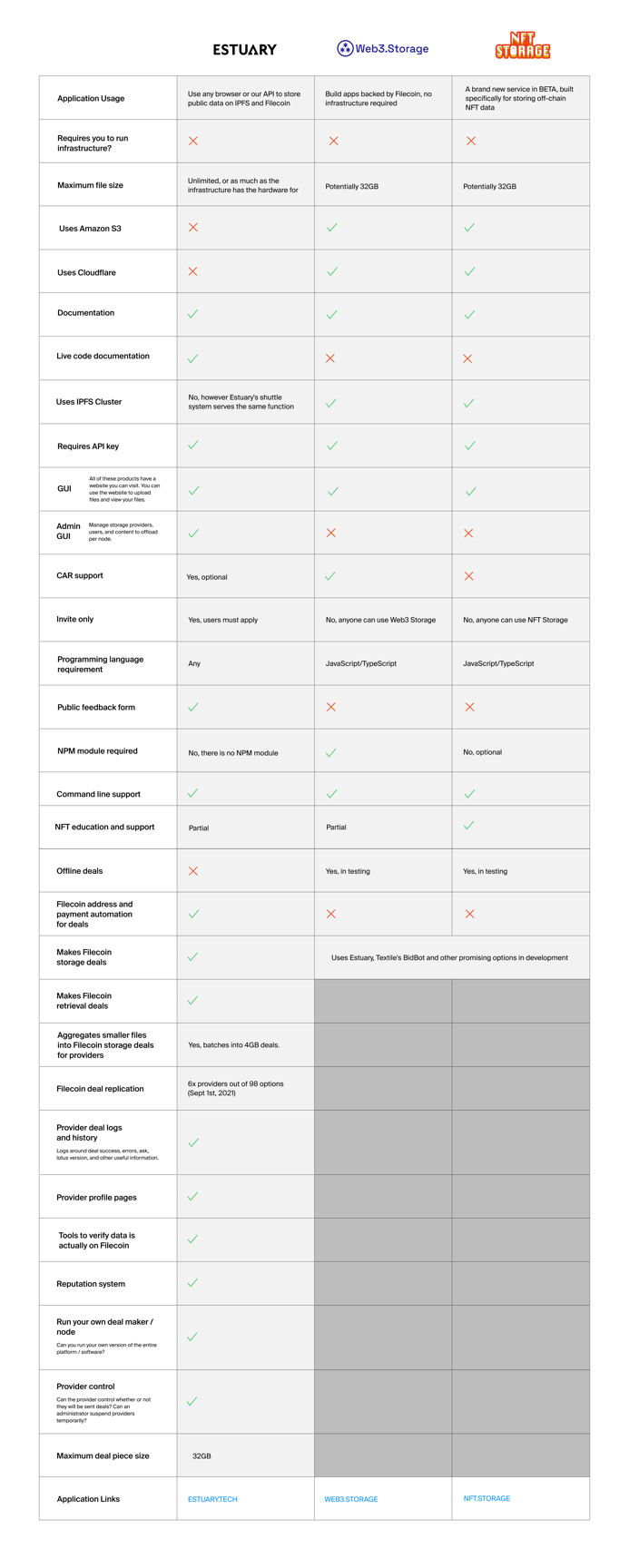
That depends — what are you building? As a web developer rooted in JavaScript, you may find Web3. storage easier to use and more suited to your development needs. Suppose you’re developing decentralized applications and want more of a handle on how your data is stored. In that case, Estuary gives you that power, though with potentially more complexity on the back end. If you’re an NFT creator that wants more control over uploaded creations, then NFT. storage is probably what you’re looking for. These three tools perform many of the same actions, but each is suited for particular use cases. Whichever you decide, dive in and have fun!
2 Technological Elements
Data coding. Through data coding, files can be compressed into an effective format to save storage. The authentication of the NFT assets is actually the authentication of the hash values signed by the creator of the NFT. Others may copy the metadata, but they cannot prove their ownership.
1 Protocol Standards.
- NFT digitalization. The NFT creators will check whether the files, titles, and descriptive sentences are completely accurate, and then convert the NFT metadata into an appropriate format.
- NFT storage. NFT creators can choose between on-chain and off-chain methods to store the metadata. On-chain storage costs more and is more congested, but the metadata will be permanently stored together with the tokens. Off-chain storage has higher limits for space, but in theory bears the risk of metadata losses. The currently available solutions for off-chain storage include centralized data centers, IPFS, and decentralized cloud storage.
- NFT signature. The creator of the NFT signs the information including the hash values of the NFT data, and then sends it to the smart contract.
3 Key Properties
- Transparent: the entire process of NFT include minting, selling and purchasing is publicly accessible. However, the storage of NFT metadata and media data is not completely transparent or available to the public. NFT creators can choose the storage method they like, but the security of most storage methods cannot be clearly assessed.
- Tamper-proof: once confirmed, NFT metadata and the complete set of transaction records are permanently stored; it only allows further addition of new information but not modification to the existing information. If the metadata is stored in a centralized server, the service operators can tamper with the data at will; and file systems such as IPFS and MEFS are tamper-resistance.
- Atomic: NFT transactions can be completed in an atomic, consist, isolated and durable (ACID) system.
- Tradable: NFTs and the corresponding products can be traded and exchanged as one wishes. The storage standard of NFTs is the key to recognizing its value, and therefore the value composition of the NFTs traded needs to be revisited.
4 Risk Assessment
With its unique attributes, NFT has brought about changes to certain extent to many areas, including Metaverse, digital artworks, collectibles, games, DeFi, public utilities and sports. This article summarizes the NFT products with the highest market cap in each category as the target group for studying the status of NFT storage.

A) Metaverse
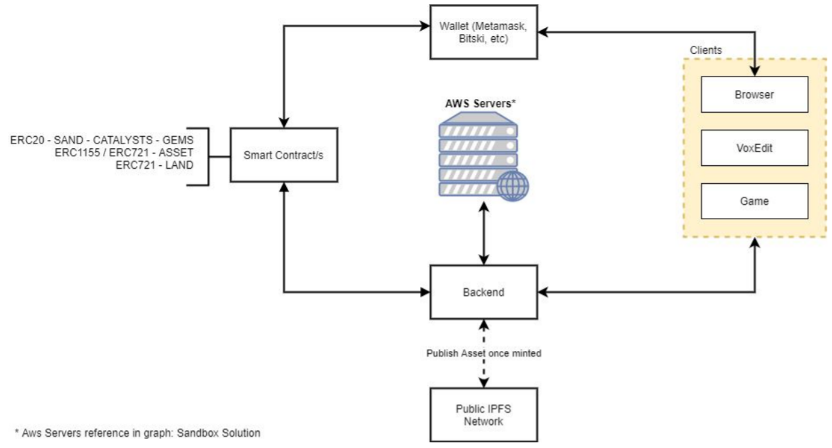
B) Digital Collectibles
Bored Ape Yacht Club is a total of 10,000 ape avatars with distinct features. All of the avatars have been minted and are available for purchase on the second-hand trading platform. BAYC announced on its official website the TokenID, SHA-256 hash value and IPFS hash of each avatar. It has also backed up the media data of each avatar in a decentralized storage system and released the back-up information.
C) Games
The mainstream off-chain storage methods currently used by NFT are: centralized, centralized verifiable, decentralized, and decentralized repairable, etc.
1 Metaverse Value Support
The reliability of NFT storage will determine the growth ceiling of the P2E gaming industry. When the industry develops to a certain level, the hidden dangers in the NFT storage will eventually receive more and more attention, and various game projects will have to make investments in improving NFT storage to lower the risks.
3 Enormous Capital Market
Let’s take buying tickets — a common economic activity, as an example. When buying tickets in the conventional market, consumers must trust the third party that provides the service. Therefore, consumers are at risk of being deceived or purchasing invalid tickets. These tickets may be fake, forged, or can be cancelled. In extreme cases, the same ticket may be sold multiple times, or non-transferrable tickets are traded in the market.
It is equally important to store the corresponding media data of the NFT. High-value transactions must be protected by infrastructure with greater security. With the growing diversification and complexity of NFT forms, the NFT storage industry will also grow in parallel with the development of projects in the NFT ecosystem.